
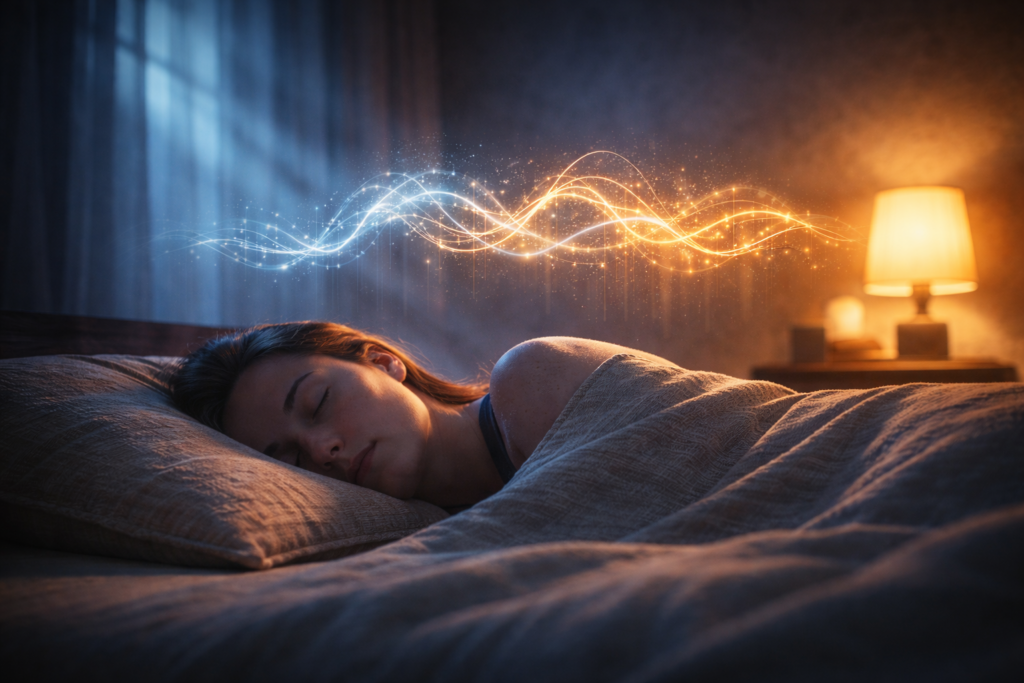
24-hour sleep music is not just ambient background sound. When engineered correctly, continuous harmonic exposure can regulate brainwave activity, reduce nighttime cortisol levels, stabilize autonomic nervous system function, and support uninterrupted sleep cycle progression.
Unlike playlists that stop, transition, or introduce abrupt silence, a 24-hour continuous stream creates neurological stability. This article breaks down the science, mechanisms, and long-term physiological impact of uninterrupted sleep music.
Understanding the Neuroscience of 24-Hour Sleep Music
Sleep is governed by oscillatory neural patterns. The human brain transitions through measurable frequency bands during rest, primarily:
- Delta waves (0.5–4 Hz) – deep restorative sleep
- Theta waves (4–8 Hz) – transitional sleep and REM entry
- Alpha waves (8–12 Hz) – relaxed wakefulness
Consistent, slow-tempo piano music with stable harmonic structure promotes entrainment — a process where external rhythmic patterns influence neural oscillations.
Brainwave Entrainment Mechanism
When auditory input remains steady and predictable, the thalamocortical system synchronizes firing patterns to external rhythm. This reduces erratic beta-wave dominance associated with stress and rumination.
The absence of abrupt silence prevents cortical reactivation spikes that interrupt slow-wave progression.
Parasympathetic Nervous System Regulation
The parasympathetic nervous system (PNS) governs recovery, digestion, and cardiac slowing. Continuous sleep music supports PNS dominance by:
- Lowering resting heart rate
- Reducing respiratory variability
- Enhancing vagal tone
- Stabilizing blood pressure variability
Music with consistent tempo and minimal dynamic spikes encourages respiratory coherence — synchronizing breath with sound.
Vagus Nerve Activation
Slow harmonic piano patterns reduce sympathetic overdrive. When the vagus nerve engages, the body transitions into a state conducive to deep, uninterrupted sleep.
Cortisol Reduction and Stress Hormone Control
Cortisol naturally declines at night. However, psychological stress elevates nocturnal cortisol levels, fragmenting REM cycles.
Research in psychoneuroendocrinology shows calming music reduces salivary cortisol, especially when exposure exceeds 30 minutes.
A 24-hour sleep music stream extends that effect across the entire sleep window.
Sleep Cycle Stability and Continuous Audio Environments
Human sleep operates in 90-minute ultradian cycles. Interruptions reset the cycle progression, increasing micro-awakenings.
Unlike traditional playlists:
- No algorithmic transitions
- No silence gaps
- No sudden tonal shifts
- No advertisement interruptions
This uninterrupted environment allows the brain to maintain slow-wave depth longer.
Why 24-Hour Sleep Music Outperforms Short Playlists
Short playlists introduce variability. Even subtle changes in harmonic structure activate auditory processing regions.
Continuous harmonic consistency reduces predictive error signaling in the brain.
In neuroscience terms, stability lowers neural surprise.
Mechanics of Harmonic Simplicity in Piano Sleep Music
Minimalist piano compositions reduce cognitive load. Without lyrics or rhythmic complexity:
- Language centers remain inactive
- Temporal prediction decreases
- Emotional overstimulation is avoided
The result is gradual downregulation of cortical excitation.
Long-Term Benefits of Continuous Sleep Music
Over time, consistent exposure may contribute to:
- Improved sleep latency
- Reduced nighttime awakenings
- Enhanced slow-wave sleep percentage
- Reduced anxiety symptoms
Long-term neural conditioning builds association between sound and physiological relaxation.
Use Cases: Who Benefits Most?
- High-stress professionals
- Parents with interrupted sleep
- Students with anxiety
- Individuals with mild insomnia
- Travelers experiencing circadian disruption
Practical Application: How to Use 24-Hour Sleep Music Correctly
- Start playback 15 minutes before sleep
- Keep volume low but audible
- Avoid sudden manual stopping
- Maintain consistent nightly exposure
Consistency is critical for neural adaptation.
Limitations and Considerations
Sleep music is supportive, not medical treatment. Severe insomnia, sleep apnea, or chronic disorders require medical evaluation.
However, as a non-invasive behavioral support tool, continuous sleep music presents minimal risk.
Frequently Asked Questions
Does music actually help you sleep?
Yes. Studies demonstrate reduced cortisol levels and improved sleep latency when calming music is used consistently.
Is 24-hour sleep music better than white noise?
White noise masks sound. Harmonic music actively engages neural entrainment mechanisms.
Can babies benefit from continuous sleep music?
Yes, when volume is safe and tonal structure is stable.
Does sleep frequency music work?
Music does not need exact frequency matching. Stability and tempo consistency are more important.
Conclusion: A Stable Sonic Environment for Deep Rest
24-hour sleep music provides neurological stability in a world of constant interruption. Through brainwave entrainment, parasympathetic activation, and hormonal regulation, continuous harmonic exposure supports deeper, longer, more restorative sleep.
Experience uninterrupted sleep piano here:
Sleepy on Harmony – 24-Hour Live Stream